We are currently experiencing technical issues with our phone system.For immediate assistance, please email us at contact@belaydiagnostics.com. We apologize for the inconvenience.
Variant Allelic Frequency to Track Therapy Response and Evaluate Leptomeningeal Disease in Metastatic Central Nervous System Cancers
Authors:
Vindhya Udhane, Alexandra Larson, Jennifer N. Adams, Rakshitha Jagadish, Anthony Acevedo, Brett A. Domagala, Samantha A. Vo, Tarin Peltier, Daniel Sanchez, Viriya Keo, Julianna Ernst, Kala F. Schilter, Qian Nie, and Honey V. Reddi.
Diagnosis of leptomeningeal disease (LMD) remains a clinical challenge due to nonspecific neurological symptoms, limitations of imaging, and the low sensitivity of cerebrospinal fluid (CSF) cytology. Molecular biomarkers, such as circulating tumor DNA (ctDNA) variant allele frequencies (VAFs), offer potential for improved detection and disease monitoring.
Methods:
Gene-level VAFs were analyzed from 118 Summit™ positive CSF specimens and evaluated in the context of clinical diagnosis, neurological presentation, neuroimaging, and CSF cytology. Longitudinal analyses were performed on serial CSF samples to assess VAF dynamics following therapy.
Results
Longitudinal assessment demonstrated that decreases in VAF post-treatment aligned with clinical stabilization, whereas rising or persistent VAFs reflected disease progression, therapeutic resistance, or evolving clonal mutations. Elevated VAFs correlated strongly with clinically confirmed LMD and were concordant with radiographic and clinical indicators of disease.
Conclusions
VAF analysis in CSF provides a quantitative biomarker for the detection and monitoring of metastatic CNS disease. These findings support its utility as a complementary tool to conventional diagnostics, offering real-time insights into disease burden, therapeutic response, and clonal evolution in LMD.
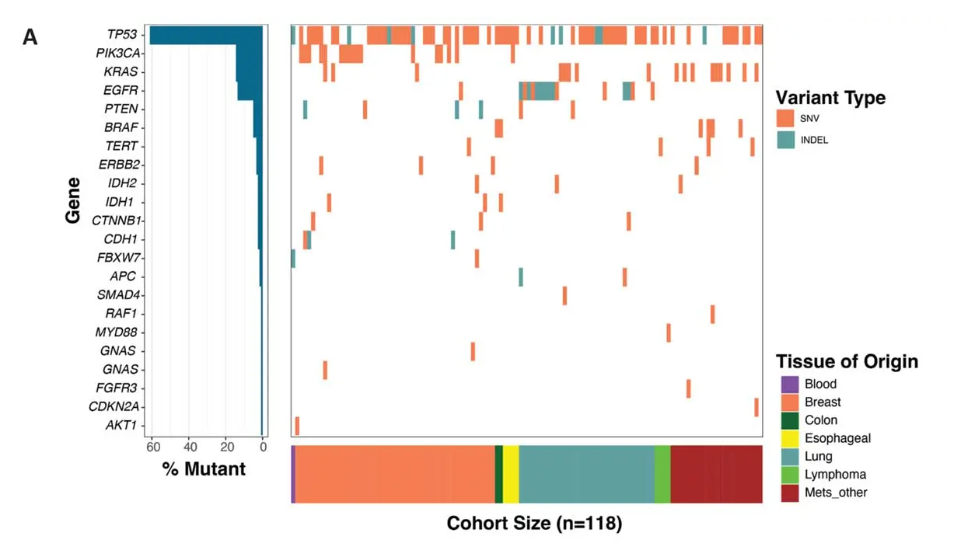
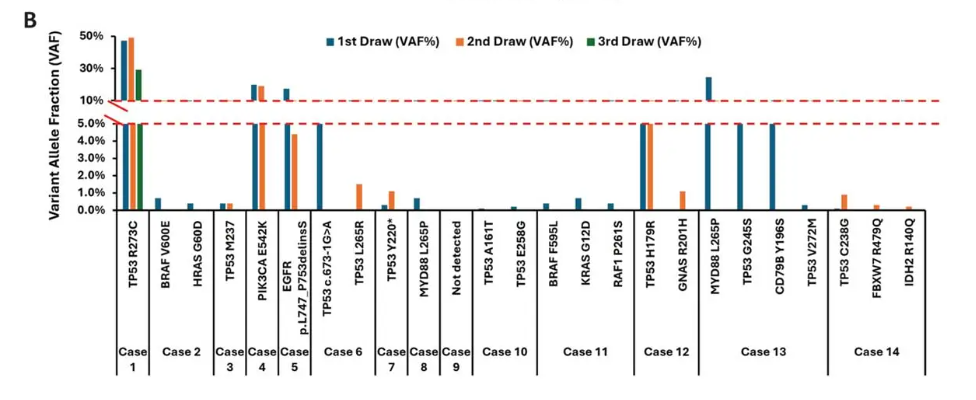
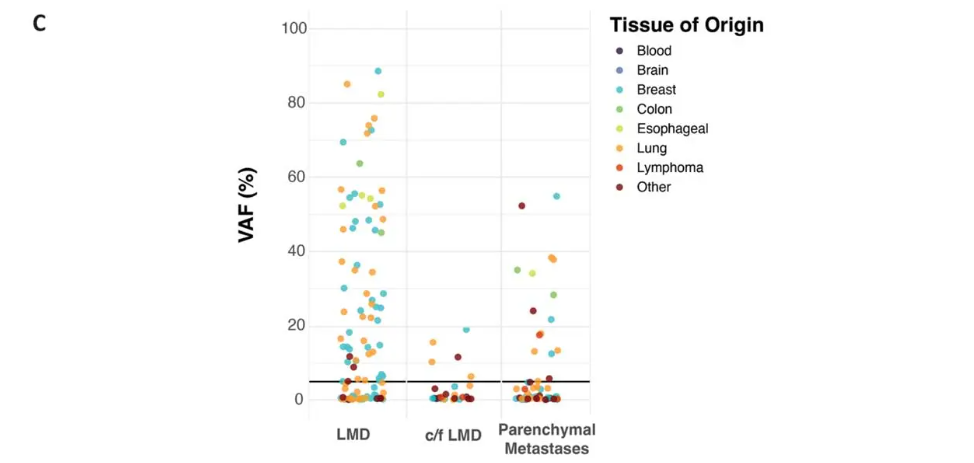
Figure 1: Variant allele frequency detection and longitudinal tracking across 118 CSF specimens in patients with suspected metastatic CNS disease.
A: Clinically significant variants were detected in 22 of the 32 genes included in the Summit panel, with frequencies varying by tissue of origin. SNV, single nucleotide variant; INDEL, insertion/deletion; CNS, central nervous system (A).
B: VAF of clinically significant variants detected in 14 cases (30 specimens collected over time) was used to monitor disease progression and therapeutic response (B).
C: Distribution of variant allele frequency (VAF) across clinical groups including leptomeningeal disease (LMD), concern for LMD (c/f LMD), and parenchymal metastases. The horizontal black line indicates the 5% VAF threshold, which was used as a cutoff associated with the diagnosis of LMD. VAF may serve as a quantitative measure to inform the diagnosis of LMD and to monitor disease progression or response to therapy (C).
Table 1: Demonstrating the validity of VAF as a quantitative measure in CSF.
A. Clinical Follow-Up of Summit High-VAF Cases for LMD Determination
Study ID
Tissue of Origin
LMD Status
Clinical Follow-Up
7
Breast
c/f LMD
Confirmed LMD
47
Lung
c/f LMD
Confirmed LMD
53
Breast
Parenchymal Mets
Confirmed LMD
146
Esophageal
Parenchymal Mets
Confirmed LMD
147
Lung
c/f LMD
Confirmed LMD
172
Pancreas
c/f LMD
Confirmed LMD
178
Lung
c/f LMD
Confirmed LMD
216
Esophageal
Parenchymal Mets
Confirmed LMD
312
Gastric
c/f LMD
Confirmed LMD
388
Breast
c/f LMD
Confirmed LMD
B. Summit Variant Concordance with Prior Tumor Biopsy Results (Variants limited to 32 genes evaluated by Summit™
Study ID
Tissue of Origin
Gene-Level Variants Detected by Summit
Variants Detected in Prior Primary or Metastatic Tumor